
Tuesday, November 3, 2026
Shopify Editions Fall '26 - A Deep Dive into the Exponential Edition

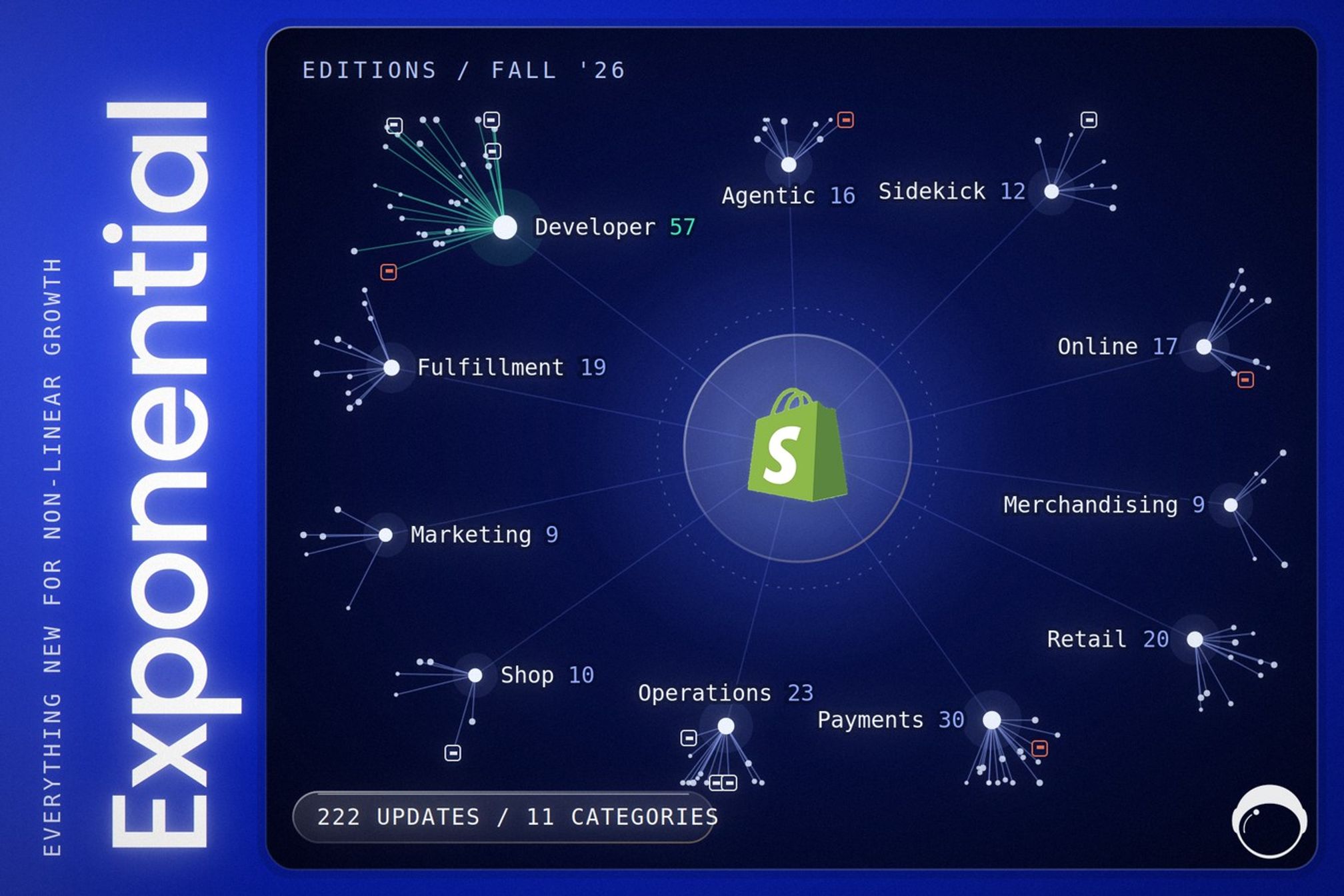
220+ updates, and one clear signal: Shopify is building for agents as shoppers, not just people. Here’s what’s actually worth your attention in the "Exponential" Edition.
by Amitav Roy · Practice Manager | Commerce & Applications · Comet CX
Every six months Shopify gathers its biggest updates into an Edition, and Fall ‘26 is called Exponential, with the line “Everything new for non-linear growth”. By the page’s own category counts, it adds up to more than 220 updates across 11 categories. They run from agentic shopping and Sidekick to fraud protection, a refreshed admin and a new theme architecture.
Shopify leads with three numbers: 1B+ products in its catalog can be discovered across AI channels, 400M+ shoppers have Shop Pay accounts (as of 30 September 2026), and Shopify Payments prevents 12K+ high-risk payments each minute. Below are the changes that matter for merchants and for the teams building on Shopify. Several items are marked early access, beta or coming soon on the page, so check availability before you plan around them.
Agentic commerce goes mainstream
The 16 agentic updates make Shopify products easier to find and buy inside AI tools. A new Shop skill lets any agent discover products, recommend them and check out with Shop Pay. Shop Pay is also coming to more agents, and the page lists Muse, Claude Duet, Grok Bot and Instinct. Merchants can sell in Google Search, including AI Mode, and in the Gemini app, with checkout powered by Shopify. You can also connect your store to Grok, Gemini, Meta’s Muse and Microsoft Copilot and manage it from inside the chat.
There is a quieter change that is easy to miss. You can now review and approve the business facts shared with AI channels, such as policies and FAQs, and get suggestions to improve them. Treat your product data and policies as inputs to these channels, not as afterthoughts.
Sidekick takes on bigger jobs
Sidekick now handles more technical work: complex workflows, staging several changes at once, computing, coding and searching the internet. Shopify says daily Sidekick sessions have grown 4.2x year over year. You can make a plan, approve it once and watch Sidekick apply changes across a whole collection. Sidekick can also review improvements it has tested with SimGym, and you choose which to apply. It helps with draft orders, pricing questions and payout or chargeback queries, and it can learn how your theme is built from markdown files.
Online: Canvas and a smarter storefront
Canvas lets you design your whole store in one view and work with Sidekick to turn ideas into a custom design. Shopify says it takes you from no theme to a launched store 20% faster. Rollouts now bundles theme, checkout configuration, catalogs and discounts into one scheduled launch, and it extends to headless builds, POS, Google Shopping and the Shop app.
Other changes in this group:
- Shop sign-in is open to businesses not on Shopify.
- Search suggestions improved add-to-carts from search by 8%.
- Arabic, Hebrew and Urdu storefronts are supported.
- B2B customers can see search results limited to their own catalog through the Algolia app.
Merchandising: cleaner product data
Product data can now be mapped per sales channel from the admin, and collections can combine products, apps or variants from multiple sources. Variants are managed from the product page, each variant can carry up to 20 barcodes, and digital products get their own app and workflow.
Retail: POS knows more of your customers
POS now recognises more in-store customers through the wider Shop Pay network, and Shopify says a known in-store customer has over 60% higher lifetime value than an unknown one. Staff can pull up a customer’s abandoned online cart and finish the sale. Scheduled stock counts, carts saved across devices, a staff activity log and bulk staff uploads round out the practical gains. In-store payments add Alipay, WeChat Pay, Satispay, Scalapay and GrabPay.
Payments: Shopify Protect and cleaner checkout
This is the second-largest category, with 30 updates. Shopify Protect blocks high-risk orders before payment is authorised, writes AI-generated chargeback responses and lets you set custom fraud rules that you can backtest against past orders. Shopify reports 60% more “product not received” disputes won.
Also worth noting:
- Shopify Managed Markets offers all-in prices with duties and taxes included; Shopify reports +50% higher international conversion.
- Shop Pay Installments for Australian businesses is in early access.
- More payout currencies are available in Australia on Advanced and Plus plans.
- Checkout gets custom fields, a tiled payment-method layout and an animated thank you page, rolling out soon.
Operations: a refreshed admin
The admin gets a complete refresh with new navigation and Sidekick built in, rolling out to all pages. Around it sit passkey sign-in, a filterable change log (coming soon), faster search, auto-generated store policies and a Shopify Credit connection to QuickBooks. Flow can now trigger when a price, tag or metafield changes, and you can build Flow automations with your preferred agent using the AI Toolkit. Analytics adds bubble maps, app events, annotations and smarter bot filtering.
Shop and Marketing
Shop gets universal checkout, so a shopper can add products from several brands to one cart and pay in one tap, plus an immersive shop.com. On the marketing side, Campaign Autopilot expands to Microsoft Advertising and Snapchat, with X Ads coming soon, and now includes SEO. Shop Campaigns reaches over 35 new markets, including the UK and Australia, and Shopify says it has led to over 18M sales. WhatsApp marketing and abandonment messages, and the ChatGPT Ads app, are also listed.
Fulfillment
The Shop Promise badge highlights trusted delivery and returns, and products with it rank higher in the Shop app and Shopify Catalog. Eligibility grew 20x. The rest is steady carrier and operations progress: DHL Express, Royal Mail and Canada Post options, native stock counts, returns and cancellation rules per market, and order edits that recalculate tax when an address changes.
Developer: the biggest category
With 57 updates, developers get the most. Highlights:
- Agent building blocks: one MCP that adds shopping to any agent or app, WebMCP tools for the full customer journey, and Catalog API additions, including searching products not on Shopify (beta).
- Platform primitives: app events in analytics, 14 new Polaris component APIs, POS printing and background extensions, and Admin API access to purchase orders for ERP and inventory integrations.
- Storefronts: Hydrogen with customer accounts and one-click deploys to Vercel, plus a new theme architecture with blocks, typed contracts and built-in Tailwind.
- Housekeeping to act on:
- Apps can no longer create or update script tags.
- Apps must migrate to expiring tokens before January 2027 to stay listed.
What this means for your build
- Agentic readiness: check whether your store is eligible for Shopify Catalog, and review the facts you share with AI channels.
- App owners: audit for script tags and token expiry now, not in December.
- Themes and storefronts: plan for Canvas and the new theme architecture. If you run a Next.js storefront on Vercel, the new Hydrogen tooling is worth a proof of concept.
- ERP and operations: the purchase order APIs and scheduled stock counts make tighter inventory integrations realistic.
- Timing: note what is early access or coming soon before you promise anything internally.
Where this leaves merchants
Fall ‘26 is Shopify spreading the same bet across every layer: agents that discover and buy, Sidekick that does the work, protection and checkout that quietly convert more, and a developer platform built for both humans and agents. Not every update will matter to every store, but the AI-channel, security and storefront changes are worth reviewing before the holiday peak.