
Friday, October 16, 2026
AI Business Operations Apps: Why the Winners Will Be Governed, Not Just Clever

By Amitav Roy · Practice Manager | Commerce & Applications · Comet CX
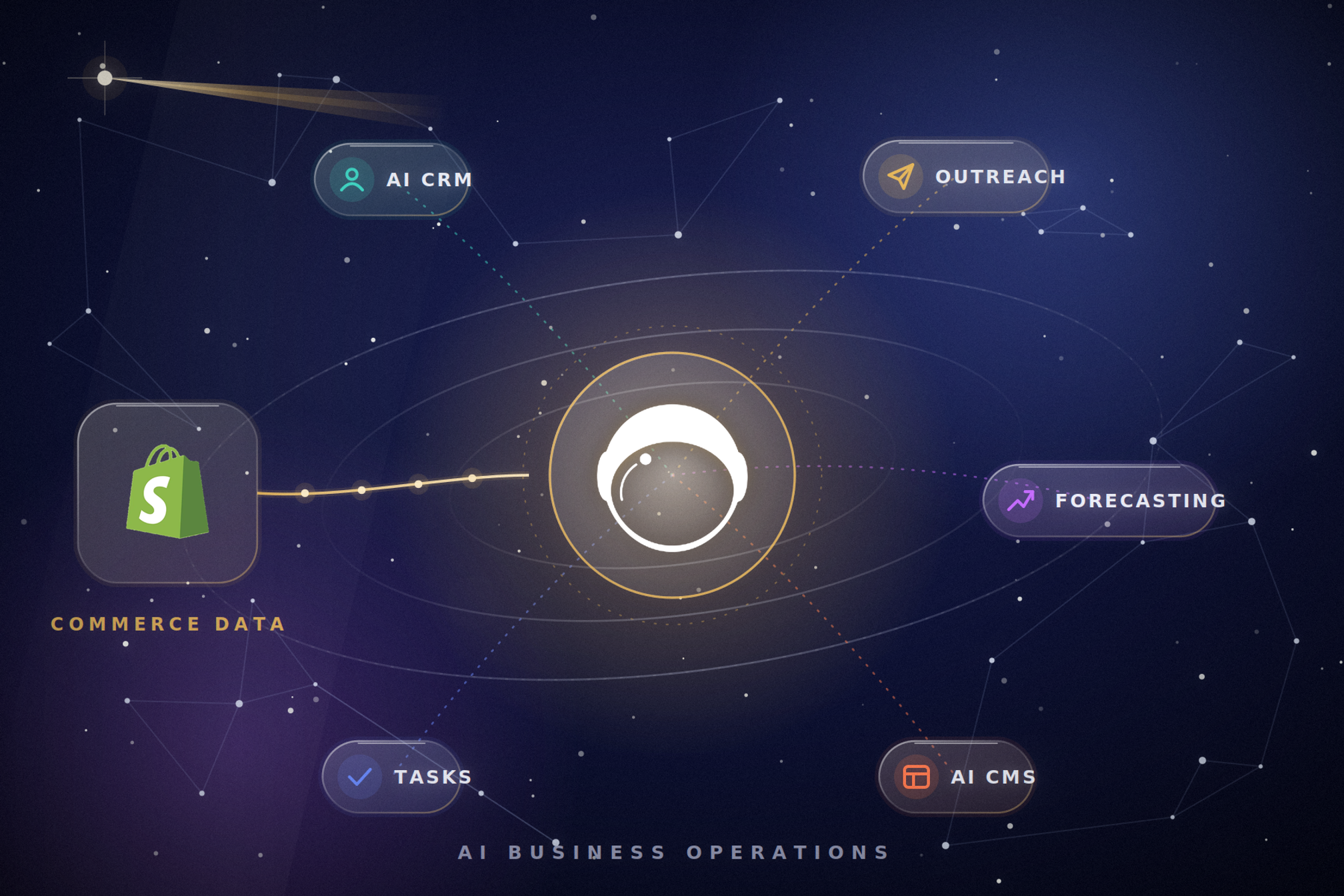
Most businesses have already tried AI as a chat window. The bigger shift is AI inside the apps that run the business: forecasting stock, keeping the CRM current, drafting outreach, routing the shared inbox, managing content. These are AI business operations apps. They sit on your operational data and recommend or take action, rather than waiting to be asked a question.
They are also where most projects quietly fail. The model is rarely the problem. The problem is what surrounds it: which data it trusts, who approves what, and what happens when something goes wrong. Here is what we think separates the apps that stick from the demos that don’t.
What we mean by an AI business operations app
It is software with a defined job, a defined data source and a defined owner. A few examples of where we are seeing demand:
- Stock and demand forecasting built on orders, inventory and ERP data.
- An AI-assisted CRM that summarises accounts, enriches records and suggests next steps.
- Sales and customer outreach drafted at scale, within brand and compliance rules.
- Inbox-to-task automation, where an incoming email becomes an assigned, trackable task instead of a colour-coded flag.
- AI-assisted content and site management for teams who publish often.
None of these is glamorous. All of them remove hours of manual handling every week.
The part that decides success: governance
The pattern that keeps proving itself is simple: let AI do the drafting and the heavy lifting, and design the controls in from day one. The same disciplines that make a large messaging platform safe at a million recipients apply to a ten-person team’s operations app.
- Human gates where decisions matter. AI proposes; a person approves. Our own internal workflows are built this way. A requirements draft moves through staged approvals, and nothing is assembled until someone gives an explicit go-ahead.
- Data contracts with fallbacks. Every field the AI relies on has a known source, a type, and a defined fallback. Missing or malformed data should trigger the fallback, not a confident wrong answer.
- Circuit breakers, not failed jobs. If one record is bad, exclude it, log it with a reason and carry on. One bad row should never stop a whole run.
- Deterministic where it counts. Sequencing, validation and arithmetic belong in code, not in generated text. Use the model for judgement and language, and ordinary software for anything that must be exactly right.
- Observability and an audit trail. Keep a record of what was decided, by whom, and why. When someone asks “why did it do that?”, the answer should already be on file.
Start read-only, then earn write access
The safest first release does not change anything. In a recent retail scoping exercise, we planned the first phase to deliver the data foundation plus two outputs, stock forecasting and an AI-assisted CRM, with no write-back to the ERP. That means teams get value and build trust before the system is allowed to change a record. Write access comes later, behind a gate, once the outputs have proven themselves.
Modular beats monolithic
The temptation is to build one giant “AI platform”. The more reliable route is separate modules, each with its own job and data, added one at a time. Customers adopt what they need and pay for what they use. It is also how we think about our own roadmap: start with one focused module, prove it, then connect the next.
Why commerce data is the right place to begin
Orders, inventory, customers and products are some of the richest operational data a business holds, and platforms like Shopify expose them through well-documented APIs. Add the integration layer that connects commerce, ERP and inventory systems, and you have a solid base for AI apps that act on real signals. Our Commerce & Applications practice builds on exactly that foundation, with custom web apps, integrations and the controls described above.
How to start
- Pick one workflow with a clear owner and a measurable manual cost.
- Define the data contract for every input before choosing a model.
- Launch read-only and let the team judge the outputs.
- Add a human approval step for anything that leaves the building or changes a record.
- Measure time saved and errors caught, then decide what earns the next module.
The takeaway
AI business operations apps are not a replacement for your team; they are a way to give your team better first drafts, cleaner data and fewer repetitive tasks. The apps that last are the ones where intelligence and governance were designed together. If you can name the workflow, the data and the person who owns it, you are closer to a useful AI app than you think.